Six years ago, Multi-Touch Attribution was the consensus answer to "how do we know which channel drove the sale." Three years ago, when iOS 14.5 stripped the cross-app signal Meta needed to stitch the path together, the consensus broke. The pendulum has now swung back toward Marketing Mix Modelling, partly on the strength of Meta's open-source Robyn project and Google's Meridian library, partly because the next-best alternative looks worse than the historic one. We get the question "do we need MMM or MTA" on roughly half our intro calls. It's the wrong question, framed almost-correctly enough that the answer matters.
The honest version: most operators in the growth-focused revenue band do not need either modelling approach in its textbook form. What they need is a clean attribution stack that reconciles to the bank, plus a small set of holdout tests and incrementality checks run quarterly. We'll walk through what each method actually is, what it costs to run properly, and where the practical line sits.
What MTA is, in plain language
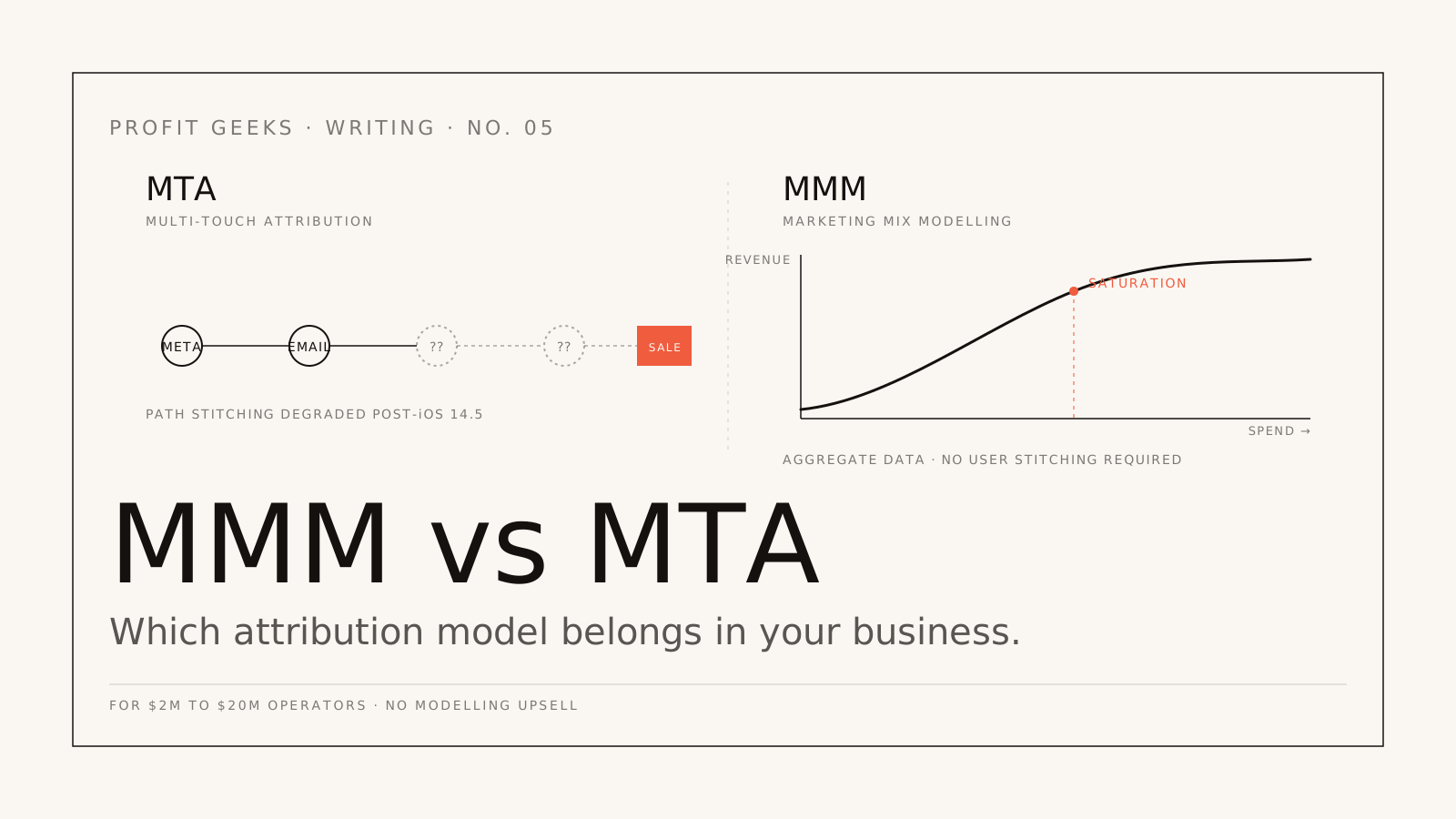
Multi-Touch Attribution is the family of models that try to assign a fraction of the conversion credit to each touchpoint a buyer interacted with on the path to purchase. A user clicks a Facebook ad on Tuesday, opens an email Friday, types your URL on Saturday, and converts. MTA's job is to decide whether Facebook gets 100% of the credit (last-click), 33% across each step, or some weighted distribution based on a model trained on historical paths.
The infrastructure assumption underneath MTA is that you can stitch the touchpoints together at all, which means recognising the same user across sessions, devices, and platforms. That stitching depended on third-party cookies, deterministic device IDs, and cross-platform data sharing, all of which have been progressively cut off since 2017. iOS 14.5 was the headline event, but Safari ITP, Chrome's Privacy Sandbox, the Australian Online Privacy Bill, and platform-side tightening have all chipped away at the signal MTA needs.
What you can still do well in MTA in 2026: in-platform attribution within Meta or within Google Ads, where the platform owns enough first-party data to stitch reliably for users who haven't opted out. What you can no longer do well: cross-platform MTA. The classic dashboard that shows "Meta drove 40%, Google drove 35%, email drove 15%, organic drove 10%" of the conversion is built on a deduplication step that no longer works at the level of confidence the dashboard implies.
What MMM is, in plain language
Marketing Mix Modelling is the family of statistical models that try to estimate, from aggregate data, how much each marketing channel contributed to revenue over time. The inputs are weekly or monthly aggregate spend per channel, weekly or monthly revenue, and a set of control variables (seasonality, promotions, weather, competitor activity, holidays). The output is a set of contribution estimates, response curves, and saturation points per channel.
MMM was the dominant attribution methodology before the rise of digital tracking in the 2000s, and it never really went away in mature CPG and FMCG categories. It came back into fashion for digital-first brands because it doesn't depend on user-level tracking. The aggregate data is still available, and the math doesn't care that you can't tell whether a buyer clicked Facebook or Google before they converted.
What MMM does well: estimate channel-level contributions and saturation curves for spend planning. What it does poorly: anything tactical, anything with a small sample, anything that needs a fast turnaround. The minimum viable input is roughly two years of weekly data with meaningful spend variance per channel. If you've spent $20K a month on Meta every month for two years, MMM has nothing to learn about Meta's contribution. If you've moved Meta spend between $5K and $80K across that period, MMM can fit a reasonable response curve.
The debate is partly real, partly tribal
The genuine technical debate is which method is more reliable for spend allocation decisions today. The honest answer: neither, on its own. MTA can give you tactical signal but only within a single platform's ecosystem. MMM can give you strategic signal but only with enough data and enough spend variance, and the response curves are six-month-old when you read them.
The tribal part of the debate is that MMM advocates often work for measurement consultancies that sell MMM engagements at $80K to $400K, and MTA advocates often work for ad-tech vendors selling stitching infrastructure at five-figure annual subscriptions. Both sides have a financial reason to talk down the other. That doesn't make either side wrong, but it does mean a vendor's recommendation is partly a sales pitch.
Where MMM actually fits in a growth-focused business
The hard answer: usually it doesn't, in its textbook form. Three reasons:
- Data sufficiency. Robyn and Meridian both want at least 104 weekly observations. Two years. Most operators don't have two years of clean weekly data with meaningful spend variance across more than three channels. Without that, the model converges on noise that looks like signal.
- Time to value. A defensible MMM engagement is a six- to twelve-week project that produces a strategic recommendation valid for the next quarter. That timeline is fine for a $200M business with a CFO and a head of marketing. It is misaligned with how a $5M operator runs the business, where the CEO is making weekly spend decisions in their own ad accounts.
- Cost. Done properly, an MMM engagement costs $40K to $120K AUD as a one-off. Updating it quarterly costs another $15K to $30K. That math doesn't work below roughly $250K monthly ad spend.
What does work in this band is what we'd call lightweight MMM thinking applied to your existing channel reports. Plot weekly spend versus weekly revenue per channel. Look for diminishing returns visually. Run a holdout test on the channel you're least sure about. Done well, this gets you 70% of the strategic value of a formal MMM engagement at 5% of the cost.
Where MTA actually fits in a growth-focused business
In-platform MTA is real and useful. Meta's attribution settings (1-day click, 7-day click, 1-day view) are MTA configurations, and the right one depends on the conversion velocity of your offer. Google Ads' data-driven attribution is MTA with Google's data on Google's ecosystem, and it materially outperforms last-click for most operators we audit.
Cross-platform MTA, the kind that lives in a third-party tool and tries to deduplicate Meta and Google touches against your CRM, is the harder call. We've deployed it for two clients in the last 18 months and walked five others away from it. The two who got value from it were both in the $15M to $25M range, both had unified CRM data with timestamped channel attribution at the lead level, and both had a marketing analyst who would actually look at the dashboard. The five we walked away from were missing one or more of those preconditions.
What we recommend instead, almost universally in the growth-focused band: clean platform-side attribution (Meta CAPI, Google enhanced conversions, GA4 with proper conversion modelling), reconciled monthly to the CRM and the bank. That gets you a number you can defend in a finance meeting. The deduplication will never be perfect; the goal is for the gap between platform-reported revenue and CRM revenue to be stable and small, not zero.
The hybrid approach we use
For most clients in our band, we run what's effectively a three-layer system:
- In-platform MTA for tactical decisions: which creative is working in Meta, which keyword group is working in Google, which audience is overspending. The platforms themselves are good at this within their own ecosystems if the events are clean. Most of the work here is making sure the events are clean (server-side tagging, first-party data, proper consent handling).
- Reconciliation against the CRM as the source of truth for absolute revenue. The marketing dashboard reports platform-attributed revenue. The financial dashboard reports CRM revenue. The gap between them is monitored monthly. A widening gap is the early warning sign that attribution is degrading.
- Lightweight incrementality testing as the strategic check. Once a quarter, we run a geo holdout or a brand-search pause or a single-channel cut on the channel we're least sure about. The output isn't a model, it's a comparative measurement: with this channel running, revenue did X; without it, revenue did Y. That's worth more than any modelled attribution number.
The output of this stack isn't a precise per-channel attribution percentage. It's a defensible ROAS per channel, an early warning system when attribution drifts, and a quarterly incrementality measurement on the channels that matter most. That's enough to make spend decisions with confidence at this revenue band.
When formal MMM does start to make sense
The threshold we use: $250K monthly ad spend across at least four meaningful channels, two years of clean historical spend data, and an internal team capable of operating the model output. Below that, the engagement cost outweighs the decision value. Above that, the response curves and saturation estimates start to materially change spend allocation, and the engagement pays for itself the first time it tells you to move budget away from a channel you'd been overspending on.
For brands above that threshold, we'd recommend Robyn or Meridian rather than a black-box vendor model. Both are open source, both are operated by Meta and Google respectively, and both produce results that are inspectable and reproducible. The cost of running them in-house, with one capable analyst, is roughly $30K of analyst time per quarter plus cloud compute. That's an order of magnitude cheaper than an outsourced MMM engagement and the recommendations are usually defensible to a finance audience.
Where the conversation usually lands
By the end of the audit call, the operators who came in asking "MMM or MTA" usually leave with one of three answers:
- Neither. Fix the platform-side instrumentation, reconcile monthly, run quarterly incrementality tests. The attribution question stops being interesting because the answers are clear enough.
- In-platform MTA only, with a proper server-side rebuild underneath. This is the most common outcome in the $5M to $15M band.
- Move toward Robyn-or-Meridian MMM as a strategic overlay, with the same platform instrumentation underneath. This is rare in our client base, and we'll typically be honest that you may not be at the scale where it pays back yet.
The trap we watch for: paying for an attribution platform or modelling engagement before fixing the data feeding it. Garbage in, garbage out applies to MMM and to MTA equally. The data hygiene work usually returns more attributable revenue than the modelling layer ever will, and at one tenth the cost.
What to do this week
If you're trying to make this decision yourself, three checks before you commit to either path. First, can you reconcile last month's platform-reported revenue to your CRM revenue within 10%? If not, the modelling layer is moot until the platform data is reliable. Second, do you have at least 18 months of weekly spend data per channel with meaningful variance? If not, MMM cannot fit. Third, do you have a marketing analyst (in-house or contracted) who will operate the dashboard? If not, the most beautiful attribution stack will go unused.
If you'd rather have someone walk through your specific numbers, the next step is a 30-minute call. Bring a month of platform reports, the matching CRM revenue, and one unanswered question about a channel you're not sure about. We'll tell you which of the three answers above applies to you, in writing, with no upsell to a $80K modelling engagement we don't think you need.
Next step
Want this kind of work in your business?
Engagement intake is capped, senior operators run every account. If your attribution is leaking and your reports have stopped making sense, the next step is a 30-minute call.