Server-side GTM is worth it for most Australian businesses spending more than $40K a month on paid acquisition, and an obvious yes above $80K. Below $20K a month the rebuild usually costs more than it recovers. Between $20K and $40K, a tracking audit is the better first step. This is how we draw the line.
Every quarter we get a few enquiries that open with some version of "we're being told we need to move to server-side tracking, can you do it." Sometimes the answer is yes and the engagement is straightforward. Sometimes the most useful thing we can do is talk the operator out of it. This piece is the framework we use to decide which, and it sits alongside our guide to how marketing attribution works.
What is server-side GTM?
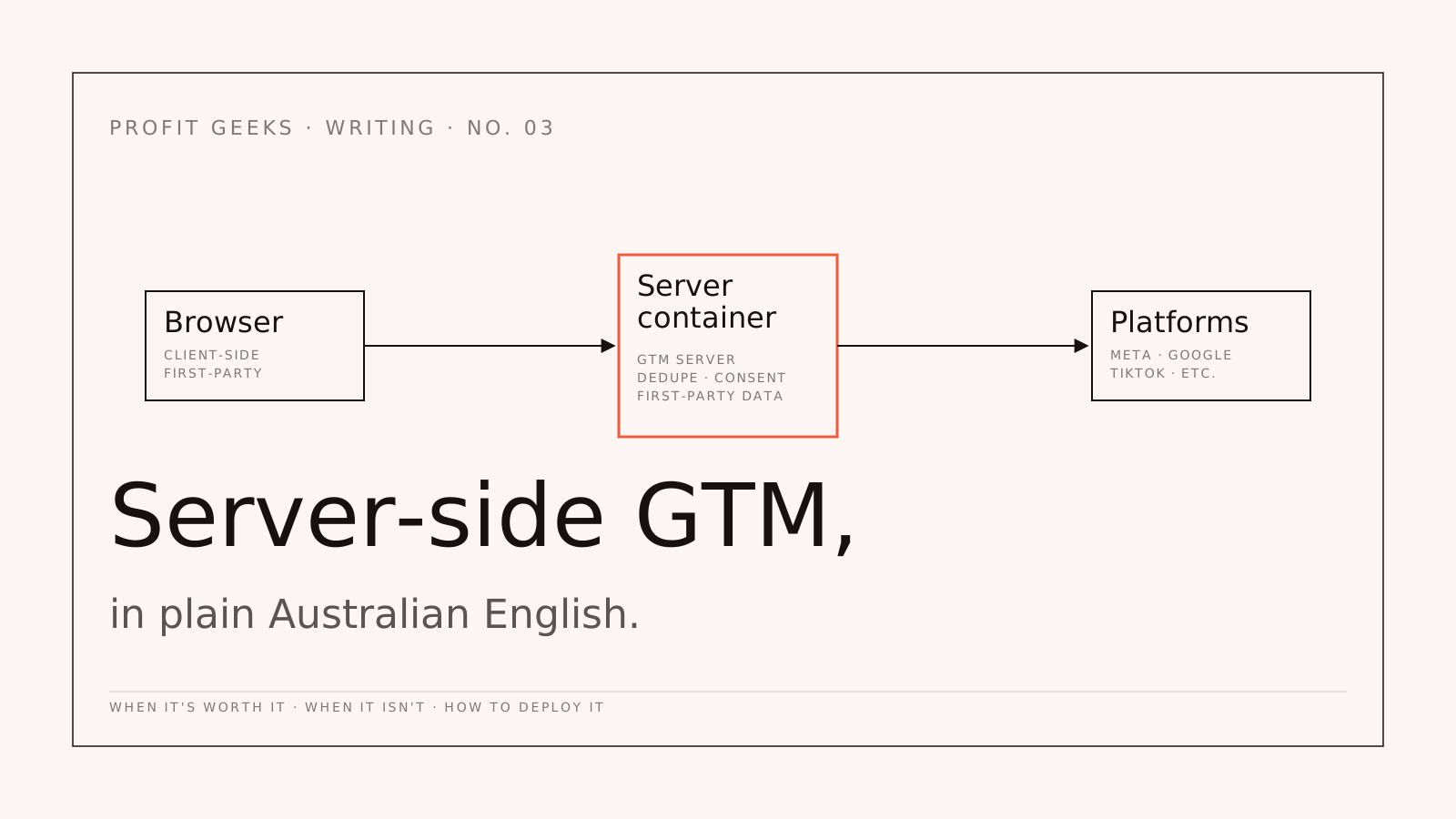
Server-side GTM (often shortened to sGTM) is a Google Tag Manager container that runs on a server you control rather than in the visitor's browser. The browser sends events to your own subdomain, and the server container decides what to pass on to GA4, Google Ads, Meta and the other platforms. It is part of Google Tag Manager itself: you create a server container and run it alongside your existing web container.
The browser tag setup most operators inherited from an agency is a Google Tag Manager web container that sits inside the page, fires pixels into Meta and Google Ads, and reports events to GA4. Every event is a client-side network call, observable in the network tab, blocked by ad blockers, suppressed by Safari's tracking prevention and iOS app tracking restrictions, and dropped if the user closes the page before the request completes.
Server-side tagging moves most of that traffic onto your domain. The browser sends events to a subdomain you control (typically tag.yourdomain.com or sgtm.yourdomain.com). That subdomain is a server-side GTM container running in your cloud account. The container parses the event, enriches it with first-party data, deduplicates against the order or lead ID, checks consent, and forwards it to the ad platforms over a server-to-server API.
What you get out of it: signal that ad blockers strip far less often, events that don't get dropped on slow connections, and the ability to attach first-party data (hashed email and phone, Meta's browser and click IDs, IP address) at the moment of conversion rather than relying on the cookie that Safari's tracking prevention just deleted.
Browser-side, server-side, or both?
Both, almost always. The browser tag still does the job only it can do, which is seeing what happens on the page and catching the click IDs when someone lands. The server container and your own systems do the jobs the browser does badly.
| Path | Where the event starts | What it does well | Where it falls short |
|---|---|---|---|
| Browser tag (GTM web container) | The visitor's browser | On-page behaviour, and capturing click IDs and cookies at the landing page | Ad blockers, browser tracking prevention, and requests dropped when the page closes |
| Server container (server-side GTM) | The browser, sent to your own subdomain | Adding first-party data, deduplication and consent rules in one place before anything is forwarded | Still needs the browser to send the event, and adds hosting and setup cost |
| Backend or CRM event | Your store, booking system or CRM, when the order or deal is recorded | Purchases, qualified leads, booked jobs and refunds, whatever device or blocker the buyer used | Only matches an ad if the click ID or customer details were captured earlier |
Source: Profit Geeks summary of the three tracking paths, October 2026.
Run them together, and give the browser and server copies of each conversion the same ID: the event ID for Meta, the order or transaction ID for Google Ads. Each platform then keeps one copy and drops the duplicate. That shared ID is what makes "both" safe rather than double counting.
When does the rebuild pay for itself?
When the revenue it recovers is larger than the cost of the build, which for most businesses happens somewhere above $40K a month in ad spend. The maths we walk every prospect through has three inputs: monthly ad spend, average order value (or lead value), and the conservative match-quality recovery you'd expect from a clean rebuild. On most engagements we see Event Match Quality move from the 3.0 to 5.0 band into the 7.0 to 8.5 band over six to eight weeks of clean data. Combined with reduced ad-blocker leakage and consent-stack repairs, that's typically 8% to 18% recovered attributable revenue in year one.
At $40K monthly ad spend, 12% recovery is roughly $58K of incremental attributable revenue. The rebuild is scoped and priced on an audit call, with a written proposal afterwards, and the scope depends on stack size. On those numbers the engagement pays for itself inside a year, and after that the system costs only its hosting. Below $40K monthly spend, the maths gets shakier; above $80K it's an obvious yes.
For operators sitting in the $20K to $40K monthly band, our usual recommendation is to start with a tracking audit instead. Two weeks, written report, prioritised fix list. About a third of those clients hire us afterwards to do the rebuild once they've seen the audit findings.
When isn't it worth it?
Three situations where we'll talk an operator out of the rebuild on the audit call:
- Sub-$2M revenue. The fixed cost of the build outweighs the recovery, even at high attribution leak rates. Better spend: fix the offer or the funnel first.
- Imminent re-platform. Moving from Shopify to Magento, or from a custom CMS to Webflow, in the next quarter. The rebuild gets undone by the migration. Sequence the work.
- The funnel itself isn't converting. Server-side measurement makes a broken funnel more visible, not more profitable. Fix the conversion rate first; instrument it second.
Two more situations where the maths is close enough to argue either way and we let the client decide:
- Heavy reliance on a single platform, particularly TikTok. TikTok's Events API is functional but the maturity isn't where Meta CAPI is. If your acquisition is 80% TikTok, the recovery numbers we're confident about don't apply.
- B2B with long sales cycles. If your conversion event is a deal close 90 days out, the platform-side optimisation benefit of better instrumentation diminishes. The reporting benefit (CFO reads dashboard, trusts numbers) is still real.
What does the server container need to receive?
The identifiers that let each platform match a conversion back to the ad click. They have to be captured when the visitor lands, stored with the lead or order, and sent with the conversion, sometimes weeks later.
| Platform | Capture at the landing page | Send with the conversion |
|---|---|---|
| Google Ads | gclid, or gbraid and wbraid on some iOS traffic | The click ID, or hashed email and phone for enhanced conversions, with the order ID and value |
| Meta | fbclid (kept as the fbc value) and the _fbp browser ID | fbc and fbp exactly as captured, the event ID, and hashed email and phone |
| Microsoft Advertising | msclkid | The MSCLKID and the conversion time, for offline imports within 90 days of the click |
| TikTok | ttclid | The ttclid, the event ID, and hashed email or phone |
Sources: Google Ads, Meta, Microsoft Advertising and TikTok developer documentation, checked 1 October 2026.
Keep the click IDs and UTM parameters in a first-party cookie or hidden form fields, and write them onto the lead or order record in your CRM. Normalise email addresses and phone numbers before hashing (lower case, no spaces, phone numbers with the country code) and hash them with SHA-256 before they leave your server. Leave the fbc and fbp values unhashed: Meta expects them as captured.
What can the server send that the browser can't?
Everything that happens after the visitor has gone: a lead your sales team qualifies, a deal won, a booked job, a refund, a repeat order. Those events start in your CRM or store, not in a browser, so only a server path can send them.
They matter because Google Ads and Meta optimise toward whatever event you feed them. Feed them form fills and they find more people who fill in forms. Feed them qualified leads and booked revenue, with values, and the same budget moves toward people who buy. The detail is in our guides to Google Ads conversion tracking, the Meta Conversions API, call tracking for phone enquiries, and lead qualification and scoring.
GA4 has its own server route, the Measurement Protocol. Google describes it as a way to add to automatic collection through the tag, not to replace it, so keep the GA4 tag in place and use the protocol for events such as refunds and offline sales.
Most of the other large ad platforms take server-side events too. TikTok, Pinterest, Snapchat and LinkedIn each accept conversions through their own conversions APIs, and Microsoft Advertising accepts offline conversion imports keyed on its click ID. Add each one when the spend on that platform justifies the work, not before.
What does the deployment involve?
The rebuild is a six- to ten-week engagement and breaks into four phases.
Phase 1: Audit (week 1)
Read-only inventory of every existing tag, event, consent rule, and reconciliation gap between the ad platforms and the CRM. We don't change anything in the live account. The output is a written report with a prioritised fix list. About 15% of the time we surface issues serious enough that we recommend a different scope than the prospect originally asked for.
Phase 2: Build in staging (weeks 2 to 4)
Server-side container deployed to your cloud account (we use Stape as a hosted option or Google Cloud Run for clients who want to keep it in-house). Web container reconfigured to send to the server container instead of directly to ad platforms. CAPI, Google Ads enhanced conversions, and offline conversion uploads configured against the server container. Consent management platform reconfigured to classify server calls correctly.
This phase runs entirely against a staging endpoint. The live site is untouched. The performance team continues running the existing setup with no disruption.
Phase 3: Cutover (week 5)
The single highest-risk week. We deploy the new server-side setup alongside the existing browser-side setup. Both run for at least seven days. We compare event volume, match quality, and reconciliation numbers across the two systems. If the new system is within 5% of the CRM (it usually is by week six), we cut the old system off.
If the new system is more than 5% off, we hold off on the cutover and do a second pass on the deduplication and consent configuration. Most engagements need this second pass; a few don't.
Phase 4: Stabilisation (weeks 6 to 10)
Match quality monitoring weekly. Consent rate monitoring (we usually rewrite the consent banner in this phase to lift opt-in rates, which often pulls match quality up another half-point). Modelled conversion ratio review. Reporting dashboard rebuild in Looker Studio so the CFO has a single source of truth.
By week 10, the in-house team has a documented operating procedure for tag changes, a quarterly review template, and a reporting layer that reconciles to financials.
How do you know it is working?
Each conversion should arrive once, through both paths, carrying the same ID and the full set of matching details. Check that before the cutover, not after:
- Preview mode in both the web and the server container shows each event leaving the browser and leaving the server.
- The Test Events tool in Meta's Events Manager shows browser and server events side by side, and whether they were deduplicated.
- Google Tag Assistant shows the Google tags firing, and the conversion diagnostics in Google Ads show whether enhanced conversions are being received.
- A monthly reconciliation of platform-reported conversions against the CRM is the standing check. Under 5% is healthy; a gap that suddenly widens usually means something broke quietly.
What does it cost?
For a typical $50K to $150K-monthly-spend operator, we scope and price the rebuild on an audit call and send a written proposal afterwards. The scope depends on the breadth of the existing stack, the number of geographic markets, and the state of the CRM integration.
For more complex setups (multiple regions, multiple brands sharing a backend, more than five active ad platforms), we scope it separately on the same call, again with a written proposal to follow.
Ongoing cost after the engagement: a Stape subscription or Google Cloud Run bill of around $50 to $200 per month depending on traffic. The infrastructure is intentionally cheap so the saving compounds quarter over quarter.
Is server-side tagging allowed under Australian privacy law?
Yes. The Privacy Act 1988 and the Australian Privacy Principles do not prohibit server-side tagging or first-party data passing. They do require that you have a current privacy policy that describes the practice, that consent is obtained appropriately, and that disclosures to third parties (including overseas) are documented.
The enforcement environment in Australia is less aggressive than the EU's, but the OAIC has been pushing harder on consent and breach notification since 2023. We always include a privacy-policy review and a consent-banner update as part of the engagement. The legal review itself is light if your privacy policy is current; if it's not, we coordinate with your legal counsel on the update.
This is general information, not legal advice. Check your obligations against the OAIC's guidance on the Australian Privacy Principles and with your own legal adviser.
The decision in practice
If you're spending more than $40K a month on paid acquisition, your reports stopped reconciling somewhere between iOS 14.5 and now, and you have an in-house performance team to operate the result, the rebuild is almost always the right call.
If you're spending under $20K, focus on the offer, the funnel, and the headline. Come back when the spend justifies the engineering. We'll tell you both things on the call without sales pressure.
If you want it done for you, our server-side tracking setup is the rebuild described above. For the models and measurement behind it, read our guide to marketing attribution.
Either way, the next step is a free 30-minute profit audit. Bring a screenshot of your Meta dashboard, a screenshot of your CRM revenue report, and one number you'd be embarrassed to defend in a finance meeting. We'll go from there.
Next step
Want this kind of work in your business?
Engagement intake is capped, senior operators run every account. If your attribution is leaking and your reports have stopped making sense, the next step is a 30-minute call.